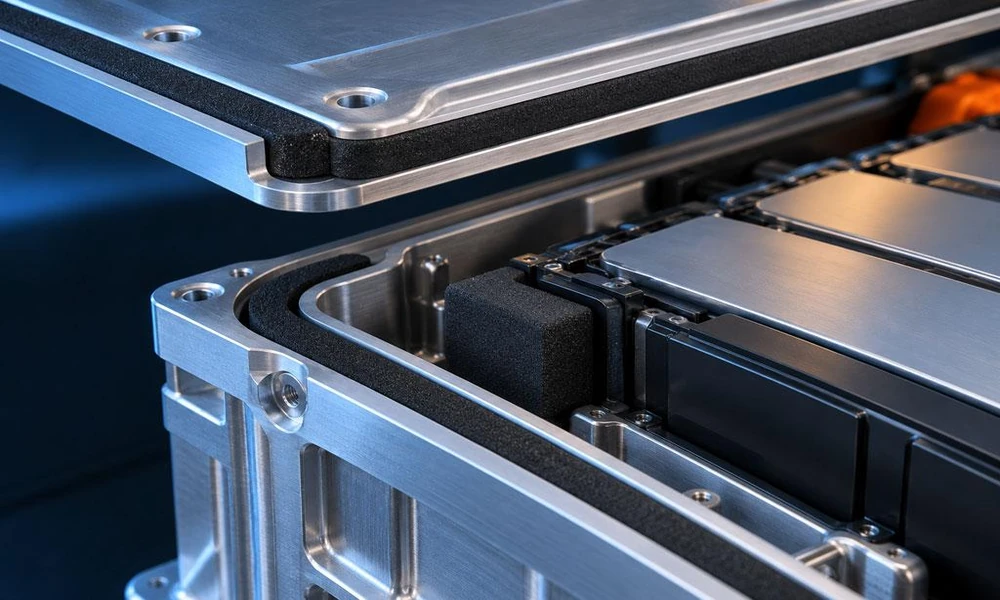



Why Sealing and Cushioning Materials Deserve Attention in EV Battery Design
An electric vehicle battery pack spends its working life inside a moving machine. Road inputs, temperature changes, and assembly tolerances all affect the relationships between its components. A rigid enclosure alone cannot address every movement or interface.
Foams and other compliant materials help engineers manage selected gaps, contacts, and sealing surfaces. They may cushion a component, support a gasket function, or reduce unwanted contact between neighboring parts.
However, choosing a foam simply because it feels soft is a poor shortcut. Its behavior under the intended load and environment matters far more than its appearance on a sample sheet.
Define the job before comparing foam families
A pack perimeter seal, a protective electronics pad, and a cell pressure management component are different applications. Each imposes its own geometry, compression range, and durability requirements.
For a sealing application, the question is whether the assembled joint maintains the required sealing performance. For a cushion, the focus may be the force transmitted through the pad and its response to repeated loading. A cell pressure management application requires an appropriate force response over the expected range of cell movement.
These uses should not be merged into a single generic specification. A foam may be suitable for one location while needing substantial additional evaluation for another.
Look beyond initial softness
Two samples can feel similar when pressed by hand yet behave differently once installed. Compression force describes the load associated with deforming the material. Compression set describes the residual deformation after a specified compression and recovery procedure. Neither property can be understood fully without its test conditions.
Thickness and joint geometry matter too. A nominal gap is only one point in a range created by component tolerances. A sound review considers the least and greatest compression the material may experience, rather than assuming every assembly matches the drawing’s nominal dimensions.
Battery material suppliers also distinguish between environmental seals, spacers, and pressure management pads.
Consider the material’s complete role
CR foam is for new energy battery applications involving cushioning, sealing, vibration damping, and insulation. It is a candidate for evaluation where these functions align with the component design. Its published V-0 flame rating applies at thicknesses of at least 5 mm, so that rating should not be assumed for every thinner part.
Ceramifiable silicone foam for battery pack sealing and cushioning applications with thermal protection and electrical insulation functions. Its published description offers another material option when the interface requires more than mechanical compliance.
The useful comparison is not which family sounds more advanced. It is which specific grade, thickness, and construction meets the requirements of a particular location.
Treat the joint as a designed component
A sealing material does not create a reliable seal independently of its mating surfaces. The joint’s shape, surface condition, compression, and fastening arrangement all need consideration. An adhesive backing, if used, adds another interface to assess.
The same principle applies to cushioning. A pad should remain where the drawing places it and should not interfere with adjacent parts, cooling surfaces, or intended vent paths. Assembly checks should confirm that the material is neither displaced nor compressed beyond the design’s intended range.
Ask for evidence that matches the application
A productive supplier discussion begins with the intended location, available gap, operating environment, and expected loading. From there, the team can identify the relevant material data and component tests.
Environmental sealing, vibration response, and cell pressure management each need evidence suited to that function. None should be inferred solely from the word “foam.”
These materials occupy relatively small spaces, but those spaces connect important components. Defining their role carefully helps engineers choose and validate the right material for the interface.